Residential Access Control Software
Stop running your community over WhatsApp.
Who comes in and who authorized it. The clubhouse bookings. The burned-out street light. The board's minutes and what the community decides. All in one place, without calling the houses to ask and without notebooks nobody can read later. Control Residencial is the system a residential community uses to manage its security and its day-to-day life, with each community's data isolated from the others and no equipment to buy: the guard's phone is enough.
What the residential access control system does
Functionality designed to maximize your productivity and efficiency
Your visitor doesn't wait in line at the gate
The resident sends a pass by WhatsApp with the date and the house. The visitor arrives, shows it and goes in. No arguing at the gatehouse, no waiting for someone to answer the phone, and no honking from the car behind.
Someone showed up unannounced, and you decide from your phone
The guard logs them at the gatehouse and the question reaches your phone: authorize or don't. The guard sees the answer instantly. That's the call nobody answers today, the one that leaves people waiting at the gate.
If that person shouldn't come in, the gatehouse knows
The community can report a person or a license plate. When someone tries to enter with that name or that vehicle, the guard gets the alert before opening the gate. The guard reports; the board confirms. Nobody gets banned by the decision of one night shift.
A delivery no longer means calling the house
You say once what to do with your deliveries: leave them at reception, bring them to the door or let nobody in. The guard types the house number and reads the answer. No more food going cold while a phone rings unanswered.
A pass that lasts as long as you say
One entry, today only, three days, a week, until a date, or permanent for the housekeeper and the gardener. And if you change your mind, you revoke it: the code stops working that very moment, with your reason on record.
Who came in with that plate, and how
Each visit is logged with how it arrived (on foot, by car or by motorcycle) and with the plate. Residents' vehicles have their own record. When you need to find out who came in with P123-456, you type the plate and there it is.
The system tells you what you can't see
If the same person has been visiting your house many times a month, it suggests saving them as a frequent visitor. If unused passes have piled up, it tells you. And passes that expired with nobody showing up close on their own.
One field to search for anything
Half a name, a house number, three digits of a plate, the phone or the pass code. The guard types whatever they managed to read and the system searches everything at once. And if that plate is reported, it comes up first and in red.
The clubhouse gets booked without a fight in the group chat
Residents see which days are free and reserve theirs; the administration approves. No more 11 p.m. messages complaining that someone got there first, and no more birthday party with two families in the same room.
The burned-out street light stops getting lost in the group chat
The neighbor reports it with a photo and the report keeps its status: received, in progress, resolved. The board sees at a glance what's pending, and the neighbor sees the report wasn't lost among two hundred messages.
Decide without waiting for the assembly
The board opens the question and each house votes from the phone. And nobody sees the results until they've voted: seeing one option ahead pulls people's votes, and a poll that pulls itself along is useless for deciding anything.
The bylaws and minutes, always where you can find them
Documents, minutes and account statements in one place, not in a WhatsApp group where nobody can find them three weeks later. And meetings keep their minutes and agreements, each with an owner and a date.
What changes for the resident, the gatehouse and the board
The resident authorizes whoever is waiting without being at home
The resident knows as soon as their visitor arrives, and again when they leave
The resident books the clubhouse, the court or the hall
The resident votes on community decisions from the couch
The gatehouse sees the day's list and marks entry and exit
The gatehouse gets an alert if that person or plate has been reported
The gatehouse searches by name, house, plate or phone in one field
The gatehouse receives packages and notes who picked them up
The board sees how many people come in, at what times and through which sector
The board publishes notices and alerts, to everyone or to one section
The board calls meetings, takes minutes and records agreements with an owner and a date
The board registers vendors with their authorized staff
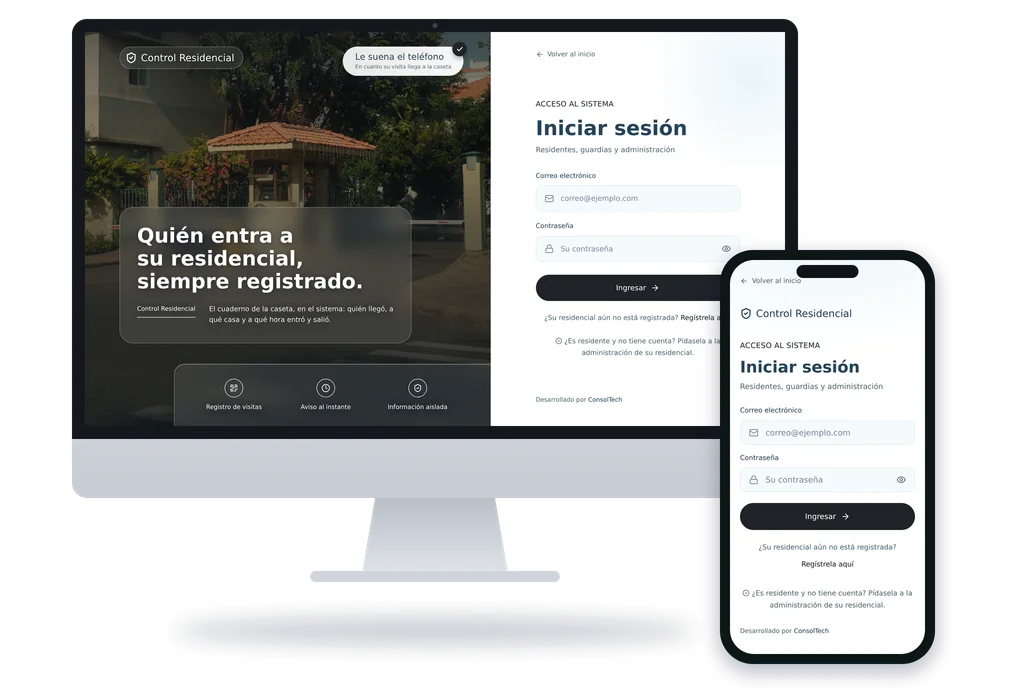
Want to see how every entry to your community is controlled?
Which communities and condominiums is it for?
For boards and managers of gated communities, condominiums and private neighborhoods who today handle everything in a WhatsApp group and a notebook at the gatehouse. Both plans include the complete system: what changes is the size of the community.
Customizations and Additional Features
Our Residential Access Control Software service includes all the main features mentioned. However, we understand that every business has unique needs.
Custom features: We can develop additional features specific to your industry or workflow.
Special integrations: We connect your system with other platforms, external APIs, or third-party services according to your needs.
Exclusive modules: We add advanced enterprise modules such as custom reporting, specialized dashboards, or complex automations.
Important note:
Additional features and customizations outside the standard service scope are subject to prior analysis and personalized quotation. Additional costs will depend on complexity, development time, and required integrations. Our team will provide you with a detailed and transparent proposal before starting any extra development.
What people usually ask us
What is a residential access control system and what should it include?
It's the software that replaces the gatehouse notebook and keeps track of visits for the whole community: who comes in, which house they're going to and when they leave. A complete one should include QR code passes, validation at the entrance, a log that can't be altered, control of recurring visitors and vendors, and a panel where the board can see activity without asking the guard for anything.
How does QR code access control work?
The resident registers the visit from their phone, the system generates a unique QR code pass and the resident sends it to the visitor by WhatsApp. At the entrance, the guard scans it with their phone's camera and the system works out on its own whether it's an entry or an exit, with the time. The pass lasts as long as the resident decides: one entry, today only, several days, until a date or permanent, and it can be revoked at any time.
Do I need to install cameras, barriers or special equipment at the gatehouse?
No. The guard uses the browser on their own phone or computer as a scanner, so there are no turnstiles, barriers or readers to buy. The system doesn't require automatic plate reading either: the plate is typed once and stays searchable, whether it was written with dashes or spaces.
Does it work for condominiums, apartments and private neighborhoods?
Yes. It's a system for communities of any shape: it's organized by section and house number, so it fits a neighborhood of houses, an apartment tower or a gated condominium equally well. The Base plan covers one section or phase with up to 2 accounts per home, and the Complete plan several sections with up to 4. Each community turns on or off the modules it wants to use.
Can more than one community be managed with the same system?
Yes. A single installation serves several communities and each one sees only its own: its houses, its visits and its users. With the Complete plan, each community also carries its own logo and color.
What if the visitor doesn't have WhatsApp?
The pass is also a short link that opens on any phone, and with the Complete plan the visitor also gets a text message notice. And if they arrive with nothing, the guard logs them at the gatehouse and the resident authorizes on the spot from their phone.
What does the board see and what reports does it get?
The board has its own module with meeting notices, minutes and agreements with an assigned owner, plus a summary of visit activity. With the Complete plan, that visit summary exports to Excel and PDF for assemblies. Everything that happens stays in a log nobody can edit or delete, not even the administrator.
How much does the residential control system cost?
The Base plan costs 50 dollars a month or 500 a year, and the Complete plan 100 dollars a month or 1,000 a year. The annual plan charges ten months. Both include the complete system: what changes is the size of the community. Complete adds several sections, up to 4 accounts per home, a text message notice to the visitor, exportable visit reports, your own branding and priority support. You can buy online or leave a request that a person handles.
Is residents' and visitors' data protected?
Yes, and in an uncommon way: personal data is stored encrypted in the database itself, not just protected by a password, and requests travel encrypted on top of HTTPS. Each community is isolated from the others, and photos are off by default: photographing whoever comes in is each community's decision.
Ready to Transform Your Business?
Join more than 100 companies across Latin America that already trust our solutions